Craft Beetle
INDOOR CLIMATE
Measures of Climate
TemperatureHeat
Humidity
Dew Point
Heat Index
Wet Bulb
Wet Bulb Globe
Real Feel
Cooling
WattsBTU
Heat Generation
Cost of Cooling
Hydration
Perspiration
Evaporative Cooling
Carbon Dioxide / Stale Air
Brown Fat
Nantou Case Study
Nantou Case Study
Let us take the Chinese city of Nantou for example. Nantou is hot and humid most of the year, which is the climate I am most familiar with. Here we see two yearly average graphs that describe daily high and low temperatures and humidity with a very useful comfort rating derived from the dew point.
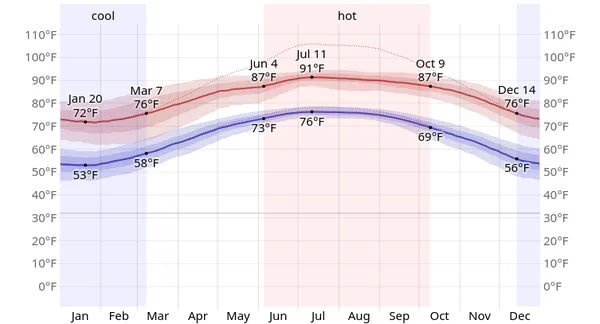
Yearly temperature highs and lows in Nantou.
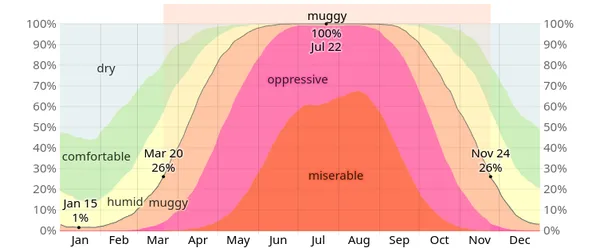
Yearly humidity and muggyness in Nantou.
In a closed and air conditioned system, the goals are to maximize insulation, minimize air exchange. As the external environment becomes more uncomfortable the indoor environment remains the same but power consumption and thus cost increases.
While this affords us the ability to ignore the outdoor environment, we are now subject to some drawbacks: high operating costs and minimal fresh air.
The alternative method is to work with the external environment and minimize power usage. We can split our year into roughly 3 categories.
Hot (May - Sep)Medium (Mar - Apr & Oct - Nov)
Cold (Dec - Feb)
Starting with the easiest category, cold. Where I live I have not had to use any central heating all through the winter.
HouseKeep south facing curtains open in the day and closed at night.
Keep windows closed on the coldest days. I often had them open because I enjoyed the cold air.
Double pane windows and insulated walls.
Clothing
Layers
Long sleeves and pants
Socks and a beanie
Food
Warm and spicy foods and drinks.
Heating
On the absolute coldest nights I used a small space heater in my bedroom. No use heating up unused spaced.
Hot showers also help warm up after yard work in the cold and inject some humidity into the indoor air.
Next is the medium transitional climate between cold and hot. In this phase the climate is not cold but also not swelteringly hot. I have not used air conditioning in this period.
House
Open windows to get maximum cross-flow.
Keep curtains closed in the day to limit sun radiation heating the interior.
Clothing
Loose and breathable cotton.
Wicking fabric.
Food
Cold drinks and frozen fruits.
Hydrate
Cooling
Oscillating fans quickly dry sweat and cool the body down at very low power usage.
Cold showers rapidly cool the body down, especially after outdoor work.
I have not yet experienced the hot period without air conditioning. I will update this section at the climate get hotter and more humid. I may find that there is a certain cut off point where not using air conditioning is no longer viable, or I may find ways to cope and be comfortable regardless.
Back To The TopComfort Zones
The more we extend our comfort zones the larger part of the year we can avoid mechanical cooling and heating.
Get use to it.Accept that you will sweat and shiver.
Adapt your clothing, eating, activities, schedule.
Respect the sun and wind and rain.
Engineer your environment.
Insulation
Ventilation
Thermal Mass
Biomass
Shade
Cost of Air Conditioning
How much does it cost to cool a house?How much does it cost to heat a house?
What are the methods of heating and cooling?
What factors affect heating and cooling efficiency? (Insulation, method, humidity, etc...)
1 Watt = 3.41214 Btu/h
Why does a house with open windows feel cooler than one with closed windows?
Is the temperature actually lower due to ventilation?Is humidity lower due to ventilation?
Is it human heat isn't accumulating like it would in a closed environment?
What is the rate of indoor heating from a single person?
How much does a single person generate in heat and humidity?
There's an experiment where people sit in a box.
https://www.engineeringtoolbox.com/persons-heat-gain-d_242.html
Air Circulation
Occilating FansCeiling Fans
Bladeless Fans
Handheld Fans
Unintended benefits
Hear more birdsBreath a lot more fresh air
Live more in the real world and not in the air conditioned box
More able to withstand heat or cold
Go outside more because doors remain open and thus invite constant in and out.
The feeling of relief and thankfulness to Allah when a breeze comes or when the rain starts.
Temperature
The first variable to consider is ambient temperature. That is the temperature of the air around us. Easily measured with a thermometer. But that doesn't tell us the whole picture.
Back To The TopHeat
Back To The TopHumidity
We also need humidity to determine how easily we can cool down via evaporative cooling. The more humid the air, the more water it holds already, the less quickly our sweat can evaporate, taking our body heat with it.
Back To The TopDew Point
Dew Point is a combination of temperature, humidity, and atmospheric pressure.
Back To The TopHeat Index
Heat Index is a combination of temperature and humidity.
heatindexchart-650.jpgHeat Index from NOAA
Back To The TopWet Bulb
Back To The TopWet Bulb Globe
Wet-Bulb Globe Temperature is a combination of temperature, relative humidity, atmospheric pressure, wind, and solar irradiance.
Back To The TopPerspiration
(Most) humans are mammals. We sweat to cool down, which is actually a pretty rare trait in the animal kingdom. We also are relatively hairless as compared to horses, cows, and apes, some of the other animals that sweat. This combination of hairlessness and sweating allows us to cool very rapidly, especially in hot dry climates.
Back To The TopEvaporative Cooling
Back To The TopReal Feel
Real feel is a common term referring to Dew Point or Heat Index or Wet-Bulb. The human body is usually at about 97.7–99.5 °F. As mammals we produce our own heat (endothermogenisis) so our concern isn't so much finding the perfect temperature so much as it is being in conditions where our internal heat generation can produce enough heat to keep us warm enough, and our external heat dissipation can keep us cool enough. There is a wide range of temperatures and humidity where can manage, beyond that we either can't get rid of the heat or can't produce the heat fast enough to remain in thermostasis.
These are all methods of converting scientific data points to a metric that more adequately describe how it feels, or more accurately, how it impacts thermo-regulation.
Screenshot_20260421_115235_Firefox.jpgFrom Scientific American
Back To The TopResources
Data and graphs sourced from WeatherSpark.com
Great source of low tech solutions Low Tech Magazine.
How Westoids have maladapted to the world: Imperial Super Profits
© 2024-2026 Craft Beetle | All rights reserved